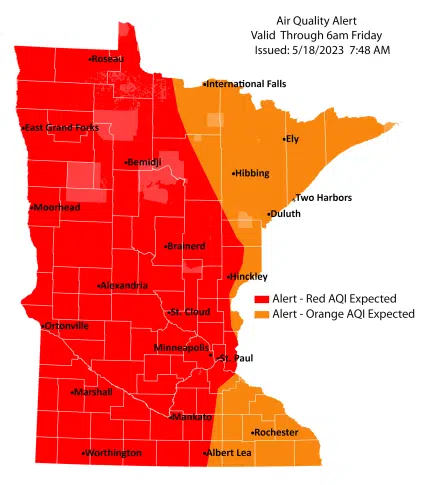
Detroit Lakes, Minn. (KDLM) – The Minnesota Pollution Control Agency has extended its air quality alert to all of Minnesotans until Friday morning at 6 a.m. due to wildfires in northern Alberta and Saskatchewan, Canada.
In a May 18 news release, the agency said a band of very heavy ground-level smoke is moving along a cold front and will continue to move south and east across the state.
David Brown, an air quality meteorologist for the Minnesota Pollution Control Agency, said the air current reacted a lot differently than they had anticipated, which is what prompted their air quality alert extension.
“We kind of expected that it would only be in the northwest part of the state and, when we woke up in the morning, it was basically covering half the state,” said Brown.
Fine particles from the smoke are expected to reach the red air quality index, which, the agency said, is unhealthy for everyone in area.
The agency recommends anyone in the red air quality zones should avoid physical exerting activities outdoors while the alert is in-effect.
“The biggest thing is just to limit physical exertion,” he said. “So exercise, strenuous activities, things like that. People that are sensitive to air pollution, their breathing gets up, their heartrate gets up, that’s when it can start to aggravate symptoms. The difficult thing with wildfire smoke is that it can get inside people’s houses too, so, it’s not necessarily the case that going indoors is going to help a whole lot because the normal HVAC filter doesn’t necessarily filter out all the smoke.”
Symptoms residents can experience in a red air quality index area are: irritated eyes, nose, and throat, coughing, chest tightness, or shortness of breath.
Exposure for respiratory sensitive individuals may worsen certain medical conditions and can lead to an asthma attack, heart attack, or stroke.
Anyone experiencing health effects related to poor air quality should contact their health care provider. Those with severe symptoms, chest pain, trouble breathing, or who fear they may be experiencing a heart attack or stroke should call 911 immediately.

Latest News



FOLLOW US FOR INSTANT UPDATES!


FOLLOW US FOR INSTANT UPDATES!