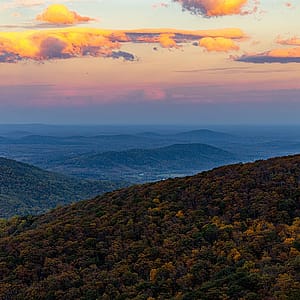
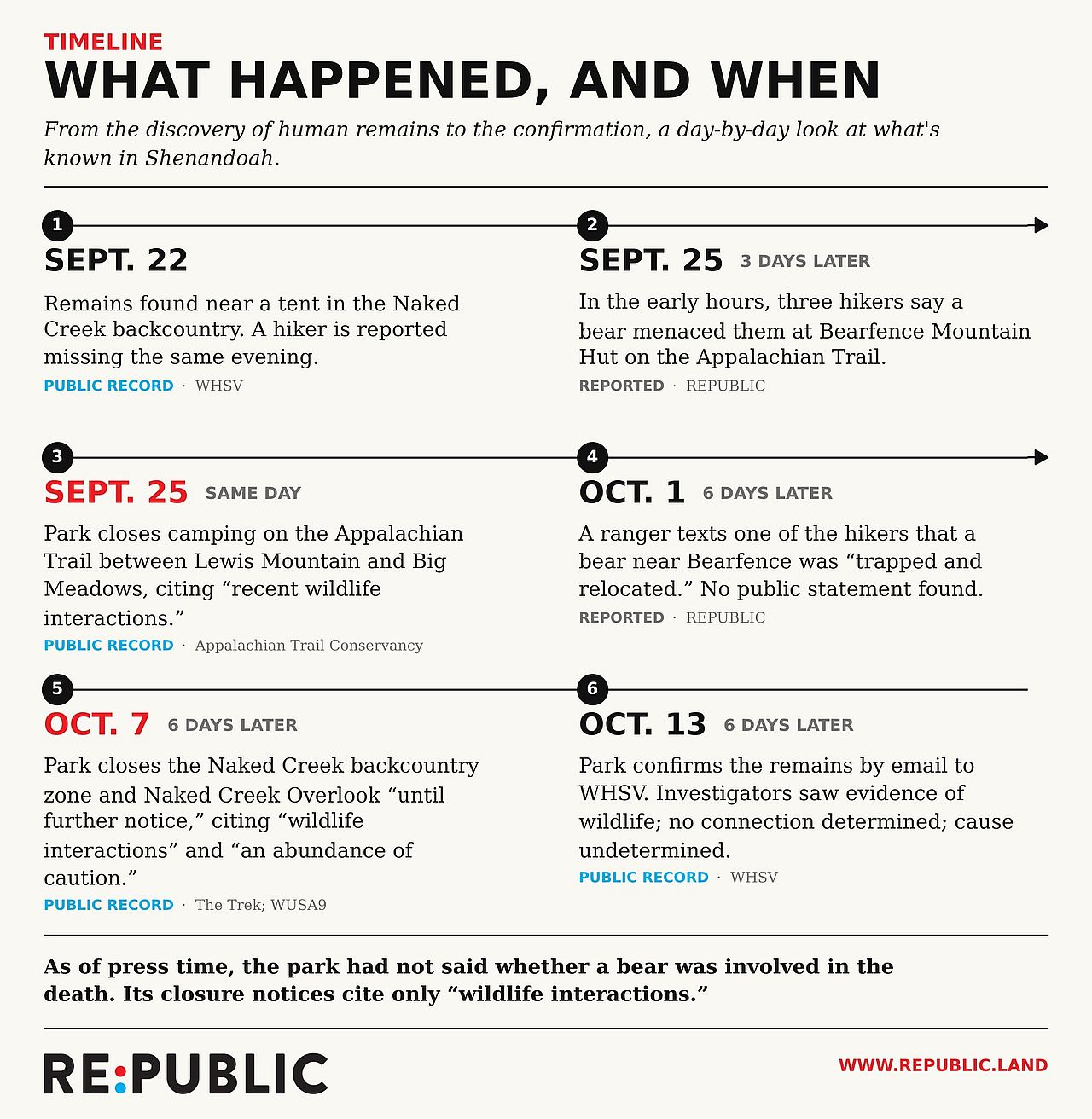
Late September, in response to reports of a missing hiker, federal and state search-and-rescue personnel ventured into a largely trackless section of Virginia’s Shenandoah National Park. On the evening of Sept. 22, they came upon human remains near a primitive campsite deep in the woods.
The fact that somebody had died in a national park wasn’t so unusual—on average, it happens hundreds of times every year—but the way officials handled this fatality stood out: They waited three weeks before saying a word about it to the public.
In a bare-bones statement sent to RE:PUBLIC on Oct. 15, officials said they’d found remains “near a tent” in the backcountry, and that investigators had observed “evidence of wildlife in the area.” The camper’s cause of death had not been determined, the release said, adding: “Wildlife safety is critical when recreating in the park.”
Park officials have said nothing since then, which is in stark contrast to Shenandoah’s long history of transparency when sharing news about deaths or injuries. They remain mum about what kind of wildlife they’re talking about. They haven’t shared any details about the victim—including name, age, and sex; the condition of the remains; and whether the person the team found is the missing hiker they were looking for. Nor will they describe what the deceased was doing in the Naked Creek backcountry zone, a vast tract of near-wilderness that requires bushwhacking to traverse.
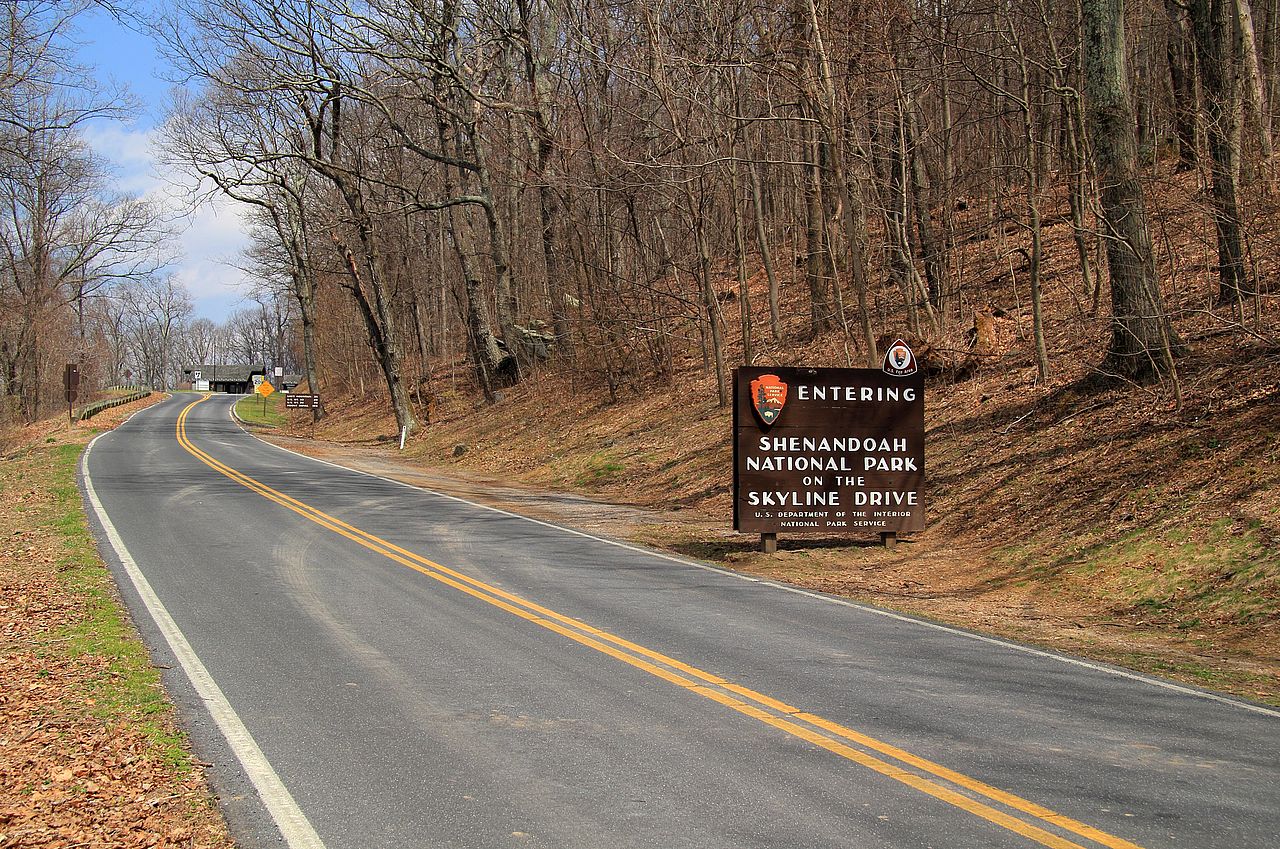
Speculation regarding this death had already blossomed online before the statement was released—fueled by accounts from park users who began sharing a combination of facts, educated guesses, and outright speculation. Using platforms such as Reddit, Facebook, and outdoor websites and podcasts, freelance sleuths have focused much of their attention on the wildlife factor, some positing that a black bear either killed the person or scavenged the body after the victim died from a different cause. Some people claimed that little of the body remained. That the victim might have been attempting to commune with wild animals—in the risky manner of the late Timothy Treadwell, who in 2003 was killed, along with his girlfriend, while living among grizzly bears in Alaska’s Katmai National Park. That the last photo taken on the deceased’s cell phone showed a black bear.
Might a bear have killed a human visitor for the first time in Shenandoah’s 90-year history? Park officials won’t say, and it’s reasonable to wonder whether their silence is related to a controversial 2025 policy directive from Washington, D.C. Late last year, the Department of the Interior issued new guidelines to all of the agencies under its control—including the National Park Service, the Bureau of Land Management, and the U.S. Fish and Wildlife Service—forbidding any public mention of deaths or serious injuries that occur on land it oversees.
Meanwhile, Shenandoah officials have not been acting as if they’re worried that a dangerous bear might be on the loose: They didn’t close the Naked Creek zone to recreational use until Oct. 7, 15 days after finding the human remains.
At the same time, they haven’t said outright that all is well. And that’s a cause for concern, because the park is in the middle of an annual onrush of visitors drawn by fall colors on its forested slopes. Naked Creek is less than two miles from a sprawling lodge and camping complex called Big Meadows, which plays host to many of those visitors.
And, as it happens, there have been alarming recent reports about a problem bear in the area—separate from whatever happened on Sept. 22. Shenandoah officials haven’t told the public anything about that, either.
Shenandoah drapes over the Blue Ridge for roughly 105 miles, from Front Royal, Virginia, to Rockfish Gap, just uphill from the town of Waynesboro. Within its lacy, irregular boundary are more than 300 square miles of woods, waterfalls, deep valleys, and mountaintops offering vistas of the rolling Piedmont to the east and the broad Shenandoah Valley to the west. Conceived as a park for the automotive age, its unifying feature is a two-lane road, the famed Skyline Drive, running down its center. Skyline’s blacktop braids with the Appalachian Trail for most of its length.
The Naked Creek backcountry zone juts westward from the park’s waist in a dumbbell-shaped tract covering hundreds of acres. One trail, demanding and lightly used, shadows its southern edge. Otherwise, the woods there are untrammeled by footpaths. Intrepid hikers have to rely on their orienteering skills to penetrate its depths. Bears, deer, bobcats, and coyotes are regular denizens.
On the night of Sept. 22, searchers from the park and the Virginia Department of Emergency Management found a tent set up in that raw landscape, with the remains nearby. Park officials have not divulged where in Naked Creek the remains were discovered. Though the search was launched to find a missing hiker, they have not said whether the victim backpacked into the area or was essentially car camping; hikers in online chats have reported seeing a car parked for several days at the Naked Creek Overlook, one of 75 scenic pull-offs sprinkled along the road’s length and a ready point of entry into the backcountry.
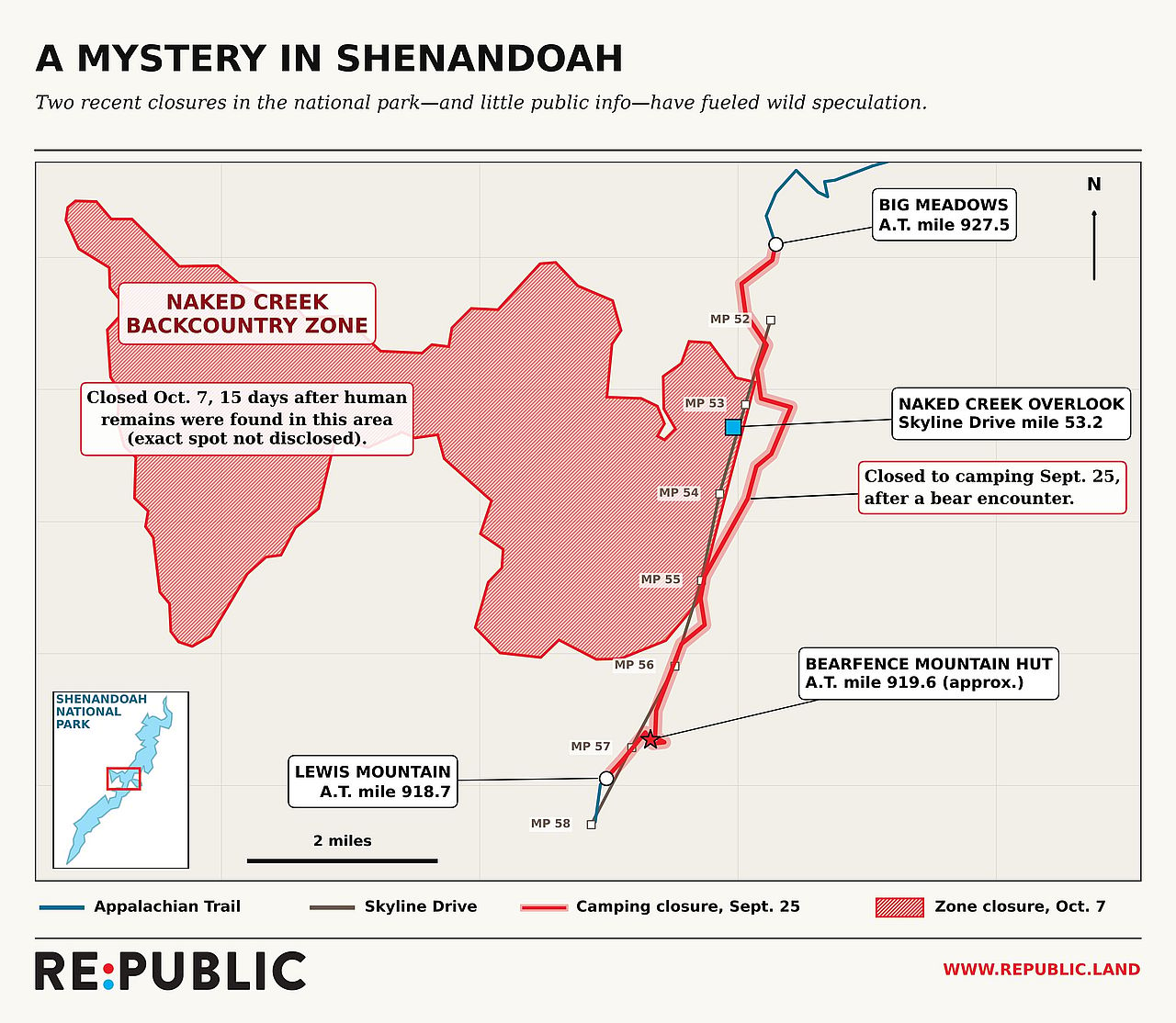
Note: Appalachian Trail mileage is for northbound hikers
The park sat on news of the find. So it was that two days later, on Sept. 24, a Washington, D.C., couple, Brad Zerivitz and Claire Ranzetta, backpacked on the A.T. to the south, unaware that remains had been recovered fairly close by, in the woods across Skyline Drive. As dusk approached, they set down their packs at the Bearfence Mountain Hut, one of about 260 spartan, three-sided lean-tos positioned along the trail about a day’s hike apart. Another hiker, Drew Marlar, was already in the shelter. A deeply experienced outdoorsman, the 56-year-old retired lawyer had thru-hiked the whole of the A.T.’s 2,200 miles in 2020. Marlar was reading the shelter’s register, a notebook in which past hikers had recorded their experiences there. He shared one recent entry describing an aggressive bear in the campsite.
“It was a week or two old,” Ranzetta, 36, recalled, “so we thought, ‘Okay, we’ll just practice really clean, careful camping.’”
“We were really careful,” said Zerivitz, 45. “We put all our smelly items in the bear box. Anything that had any smell at all.”
After the trio ate dinner together, Zerivitz and Ranzetta repaired to the small backpacking tent they’d pitched nearby. Marlar slept on the hut’s floor. After midnight—that is, in the early hours of September 25—Zerivitz was woken by a “knock” just outside. He looked past the sleeping Ranzetta to see that the tent’s rain fly was slashed. He pulled on a headlamp and looked the other way, out his own door, to catch the reflected eyes of a bear standing just a few yards away.
With that, a fraught showdown commenced: Zerivitz leaped from the tent, shouting and waving his trekking poles in an effort to shoo the animal off. At Shenandoah, that is typically enough to send a bear packing. Not this time. “It would back up a little bit, but it wouldn’t go away,” he said. “It kept coming back.” The bear advanced on him repeatedly. At one point it charged, and got near enough that he whacked its head with a trekking pole.
Marlar, roused by the commotion, appeared at his side. “I had never seen a bear act like this,” he recalled, estimating the animal to be 5 to 5.5 feet long and 250 to 275 pounds. “It was really unnerving. It just wasn’t backing off. At one point, it lay down and just kind of stared at us, and I had never seen a bear do that. It kind of bluff-charged us, and then just lay there, looking up at us.”
Ranzetta, meanwhile, rushed to pack everything up. Marlar urged the couple to join him in the lean-to; they did, leaving the empty tent behind. Once in the shelter, they watched as the bear circled them and swatted at the bear box. A few minutes later, they heard it shredding the tent and snapping its aluminum poles. “He was . . . in the bushes, maybe eight to ten feet from us, and he was not backing off at all,” Marlar said. “That’s when we read the rest of the [register], and we found an older entry that said a bear had tried to come at people in the shelter. That’s when we decided we had to get out of there.”
The three gathered up the ruined tent and fled to Skyline Drive, where Ranzetta phoned the park’s emergency number. The dispatcher told her a ranger was unavailable until 7 a.m. So they walked less than a mile down the road to the Lewis Mountain Campground and holed up in the restrooms.
“There was no sleep,” Marlar said. “I don’t think I tried.”
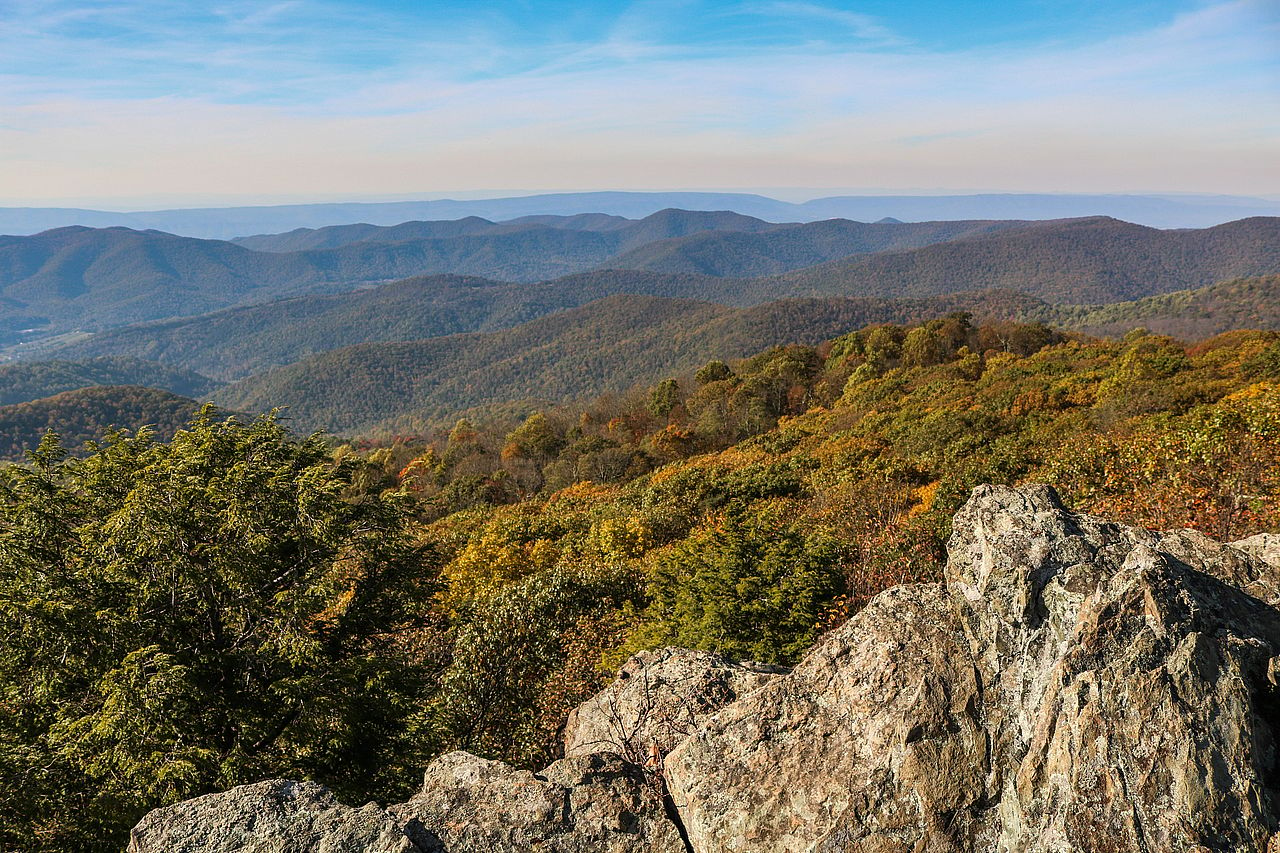
In the morning, ranger Melissa Moses arrived and drove Zerivitz and Ranzetta to their car. The ranger later collected the few pieces of gear the bear had stolen from them: a washcloth, ripped in half; a well-chewed trekking pole; a sock; a bandana. On Oct. 1, Moses texted Ranzetta to say she had “been advised that a bear in the bear fence area has been trapped and relocated.”
Within hours of the incident at Bearfence Mountain Hut, the park closed the A.T. to all camping along the nine miles of trail between Lewis Mountain Campground and the Big Meadows lodge. Its vague explanation: “recent wildlife interactions.”
Naked Creek stayed open. The public remained unaware of the grim discovery there even as the park announced on Oct. 7 that it was shutting down the entire zone “due to wildlife interactions and out of an abundance of caution.” What prompted that decision, more than two weeks after the Sept. 22 discovery? That’s anyone’s guess.
But the announcement of the zone’s closure prompted the previously mentioned flurry of online gossip, and, in short order, questions to park officials from the media. The park’s staff stonewalled those inquiries for days. A RE:PUBLIC reporter drove to Shenandoah’s headquarters on Oct. 15, in an attempt to learn more. They were ordered off the property by a uniformed park worker who refused to give her name and told them it was “inappropriate” for them to “show up here like this.”
The reporter later emailed Interior’s communications office, asking for more detailed information. In their response, they suggested submitting a request using the Freedom of Information Act, adding: “The Department and the National Park Service continue to provide public safety information, statements, news releases and incident updates as appropriate, while respecting investigative processes, privacy considerations, next-of-kin notifications and, in some cases, requests from family members not to release identifying information.”
Such a response is not typical of Shenandoah or other National Park Service units. When Maryland hiker Robert Bieri went missing in Shenandoah in July 2025, the park announced the search for him while it was underway and the discovery of his body within hours of the event. Hut closures due to aggressive bear activity, likewise, have been routinely shared with the public at Great Smoky Mountains National Park. Elsewhere, falls and other accidents, searches, and rescues have been publicized.
“In the three years I was superintendent of Mount Rainier National Park, the park experienced over 20 fatalities,” recalled Jonathan Jarvis, head of the NPS under President Barack Obama. “The NPS protocol across the entire system was to be as transparent as possible, with obvious sensitivity to the families and only after they were notified. … The policy was based on the public’s right to the information, and the value of prevention.”
In reference to Interior’s 2025 policy change about public mention of deaths and injuries, Jarvis said, “I can only speculate on the motivation for such a backward policy.” He suggested it may be grounded in political leadership at the department having “a lack of experience with land management agencies and the frequency of public injury and death. [Or] that they want to make sure they cannot be considered at fault for the major cuts to the NPS staffing and budget that resulted in the accident.”
Another former park service higher-up called the new guidelines “counter to decades of practice that recognized the importance of informing the public of any potential dangers in a park, especially if there may be further threat to life.”
Since the Interior internal order, some parks have detoured from the policy. In an April 20 release, Great Smoky Mountains officials warned visitors of six aggressive bear incidents in the park the previous weekend, “including one case where the bear bit a visitor who entered a closed area.” That park used the incidents as a teaching opportunity, offering detailed advice on avoiding conflict with its resident bears.
In May, officials at Glacier National Park issued a written alert that the body of a missing hiker had been found in the park with injuries “consistent with those sustained by a bear encounter,” and that park wildlife experts and rangers were “assessing the area for bear activity and any ongoing public safety concerns.”
Such clarity has yet to materialize regarding the recent events in Shenandoah’s Central District, however, which doesn’t sit well with the hikers who endured the scare at Bearfence. “It’s frustrating, because the information’s not getting out there,” Ranzetta said.
“It’s truly insane,” Marlar said. “If I had known there was a search for a missing hiker around there, and a body found, I might have acted differently. I might have changed my plans.”
While closing the A.T. to camping makes sense, he said, to leave visitors to the nearby campgrounds in the dark does not. “There are areas at Lewis [Mountain] that are really close to the trail, and people are going to be cooking right there. Not everybody is careful about it. We were careful, and look what happened.
“It’s super dangerous,” he said. “It’s not okay.”
This story was produced by RE:PUBLIC and reviewed and distributed by Stacker.